Beth Curran
For some time, I’ve wanted to share stories of schools that have successfully implemented a Singapore Math curriculum.
To present the first such case study, I asked my colleague Beth Curran to summarize the adoption process at St. Anne’s-Belfield School, an independent Pre-K to 12 school in Charlottesville, Virginia.
Please contact me if your school has a story to contribute.
Our Journey to Singapore
by Beth Curran
Preschool – 6th Grade Math Department Chair, St. Anne’s-Belfield School
Singapore Math Teacher and Trainer
 It all began with a strategic plan. In 2011, St. Anne’s-Belfield School released its 2011-2016 Strategic Plan. The first of six goals focused on teaching and learning in the 21st century. Key elements to this goal included teaching with depth rather than breadth, teaching critical thinking and problem-solving skills, improving the quality of our computation, and ensuring that our pedagogy reflects researched based best practices. The Action Plan that followed gave direct mention to Singapore Math as a curriculum to explore.
While teachers felt strongly that the students were leaving our Lower School (grades Kindergarten through four) very well prepared for Middle School (grades five through eight), we had to ask a tough question; could we be doing better?
Why Singapore Math?
As the Lower School Math Coordinator at the time, I was charged with taking a critical look at the Lower School’s current math curriculum and learning all I could about Singapore Math. The more I learned, the more I was convinced that Singapore Math would be a great match for us. It was almost as if the Strategic Plan was written with Singapore Math in mind. The curriculum teaches concepts to mastery, focusing on depth rather than breadth. Critical thinking and problem-solving are embedded within the curriculum, not taught as a stand-alone unit. Concepts are introduced, practiced, and applied immediately to solve problems. Computation and numeracy are also a major focus. Check, check, and check!

Learning Village at St. Anne’s-Belfield School
Not all of the homeroom teachers were as enthusiastic as I was. It was a daunting task convincing them that learning a new math curriculum, on the tails of learning a new writing curriculum, was a good thing. St. Anne’s-Belfield’s Head of School, being the visionary that he is, saw an opportunity to not only implement a new math curriculum, but to change the way math instruction is delivered at the Lower School level. If we were going to ask our teachers to become Singapore Math specialists, why not hire and train dedicated math teachers? And that’s just what he did. Four math teachers were hired to deliver math instruction and these dedicated math specialists would co-teach math with the homeroom teacher taking on a supporting role. This had an added benefit of cutting our student to teacher ratio in half during math class.
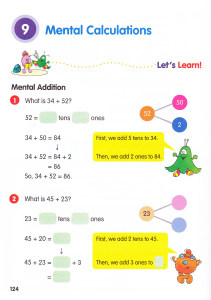
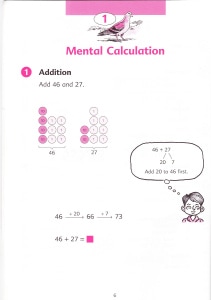
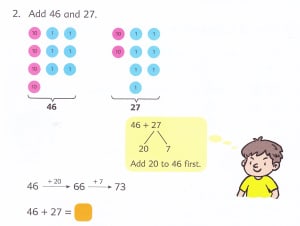
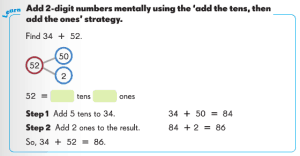
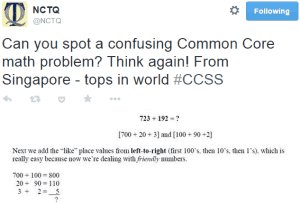
With the faculty in place and the Primary Mathematics materials ordered, we set out to train our dedicated math teachers in Kindergarten through sixth grade. We contracted with Cassy Turner, Singapore Math Specialist and Trainer to work with our math teachers for an intensive one-week boot camp. We learned the ins and outs of mental math and the bar model. We asked questions, practiced, collaborated, practiced, designed an implementation schedule, and practiced. Cassy’s enthusiasm and extensive knowledge left us feeling confident to tackle the upcoming year. We knew professional development was crucial to a successful implementation and with that in mind we continued our relationship with Cassy throughout the year. She made three more trips to the school, observing and teaching lessons and providing her guidance to keep us on track.
Successes and Challenges
Fast forward to today. We are now a year and a half into our implementation. Our students are stronger problem-solvers than ever before. Their computational skills have shown marked improvement. Their overall sense of number and place value has increased. Our students are confident and persevere through challenging problems.
We have done a lot of things really well. We understood and placed value on professional development. This is not a curriculum that can be picked up and taught from the Teacher’s Guides. Most teachers did not learn math the way that a Singapore Math curriculum is taught. Training is key. If not trained, teachers will revert to teaching math the way they learned it. Having a successful plan for ongoing professional development is critical to a successful implementation.
We put value on mathematics instruction at the Lower School level. We saw the need for math specialists and took a huge financial risk to improve our instruction.
We implemented the curriculum in Kindergarten through sixth grade. We felt so strongly about the benefits of the curriculum that we knew that even one or two years of exposure would be better than none. This has been one of the most challenging hurdles of our implementation. We worked with Cassy to anticipate and develop a plan for “back-teaching” missing skills. In grades three through six, this plan guided us through our first year and fortunately, Kindergarteners through second grade students benefited from needing very minimal “back-teaching.” Developing a relationship with a knowledgeable Singapore Math consultant is crucial.
If there was an area for improvement, it was parent communication and education. We hosted a parent night early into the school year to give parents an overview of the curriculum and a brief introduction to some of the components that are unique to Singapore Math. That wasn’t enough. Parents didn’t learn math the way their children were now learning it. The focus of Singapore Math is to develop conceptual understanding before learning the mathematical steps or procedures. Parents need to understand and support the school in teaching math this way. Parent education is not an option; it is a requirement of a successful implementation. In our second year, we designed a plan for parent chats spread throughout the year with topics including fact practice, mental math strategies, and bar modeling as a tool for problem-solving. Your professional development provider or consultant can assist you in designing a parent education program that meets the needs of your school.
Our journey continues and our students are stronger math students as a result. The first year was clearly the most challenging. Our commitment to professional development, perseverance, and acceptance of this unfamiliar approach to teaching math has guided us and we are confident that each passing year will continue to confirm the benefits of teaching a Singapore Math curriculum.

 For 2015, I submitted similar proposals to both NCTM and NCTM…and BOTH were accepted. Woot! And good news, my co presenter will be Lauri Susi of

 2015 NCSM Annual Conference – April 13-15, 2015