My students love math class. In fact, many will tell you math is their favorite subject. Why? They’ll tell you it’s because Singapore math is fun. I’d say it’s because once they understand how math works, they become confident in their abilities. So what exactly is Singapore math?
Wait, math from Singapore? Isn’t that some little island in Asia?
Primary Mathematics is based on a program of study introduced by the Ministry of Education in Singapore in 1981, a time when Singapore’s students were middling in math. Fifteen years after the adoption of its new Primary Mathematics Syllabus, Singapore students led the world in global Math achievement tests (Singapore topped international rankings first in 1995, and again in 1999, 2003 and 2007).
The Singapore math success story—from mediocre to world-class in a generation—is no secret. The curriculum provides students with a solid foundation in mathematics by focusing on visual understanding, connections, number sense, mastery, and word problems.
Concepts in Singapore Math® are taught in a concrete – pictorial – abstract sequence
Hands-on manipulatives or real life objects are used to demonstrate the concept, then students use and create pictorial representations. This interim visual step is typically missing from many curricula used in the U.S. It provides a transition from the words to an abstract algorithm. The goal is always to use the concrete and visual components to get to a standard algorithm.
To gain number sense, students are taught to make connections between topics. While first graders will still work on “fact families”, Singapore math also uses a pictorial representation called a “Number Bond” to help students see the connections between addition and subtraction.
Fact Families: Number Bonds:
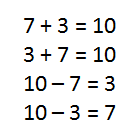
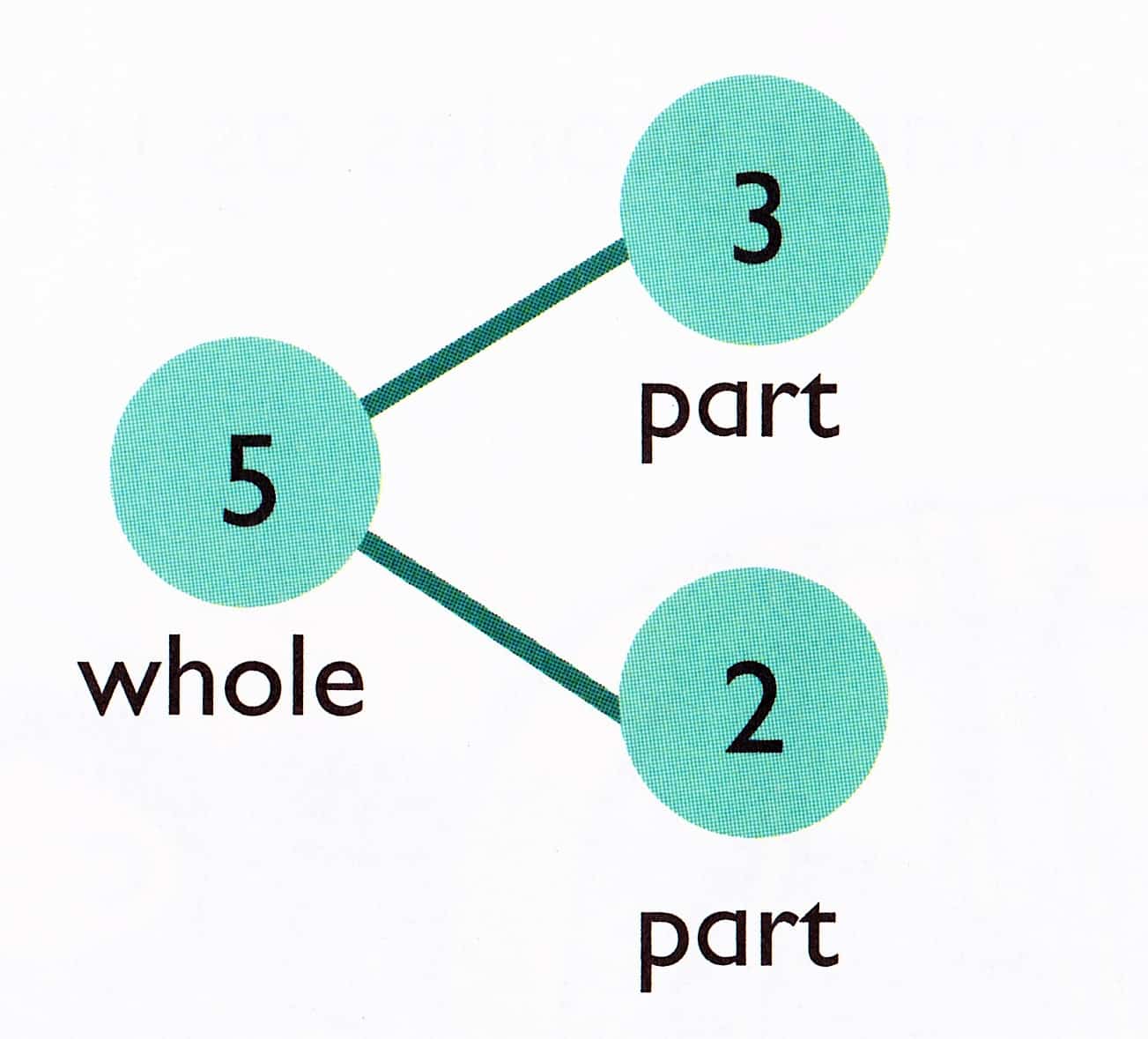
Understanding numbers and operations is critical to mathematics
Singapore materials focus on place value to provide a deep knowledge of numbers. As students work with and manipulate numbers, they work towards fluency by learning and using mental math strategies.
For example:
“If I know that 7 and 3 make 10, I could solve the problem of 47 + 8 by breaking the number 8 apart into 3 and 5. Adding the 3 to 47 gives me 50, then I can easily add on 5.”
These mental math skills show flexible thinking and provide a “check” students use when the algorithm is learned. I was in a first-grade classroom last week where the teacher was talking about addition and subtraction strategies with her students. They were working with numbers like 9 + 5 and the teacher had asked the students how they got their answers:
“I counted on from 9”
“I took 5 apart to 1 and 4 and made a ten first”
“I used automaticity!”
To get to mastery, students work on focused concepts and skills. U.S. curricula are typically criticized for being “A mile wide and an inch deep”. Topics continually spiral and “It’s ok if kids don’t have their multiplication facts memorized this year, we’ll reteach them again next year.”
And next year and next year…
Not so with schools using Singapore Math®. In first grade, students will learn multiplication of twos and threes within 40. In second grade, they’ll master multiplication and division by 2,3,4,5 and 10. Each year builds on the prior foundation and extends student understanding. By the end of third-grade students will have mastered all of their multiplication tables as well as multiplying and dividing by a single digit. Yep, they will even become proficient with the dreaded “long division algorithm”.
Understanding problem solving
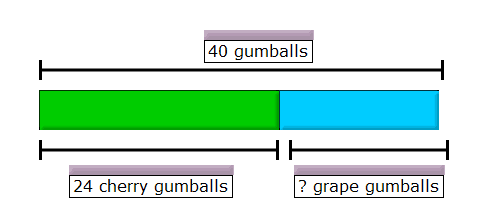
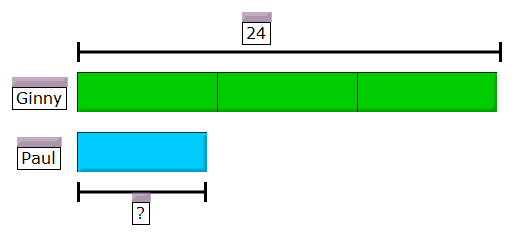
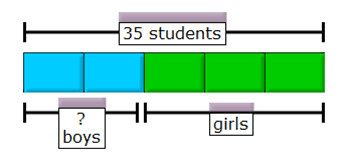
Another component of mastery is the ability to take what you already know and apply it in a new context. Remember being tortured in school with story problems? The heart of the Singapore curriculum is an emphasis on problem-solving — and that means word problems. They are incorporated throughout the materials to provide context to each topic as it’s taught. The key to solving these begins with a bar model or pictorial representation of the word problem. For instance:
1) Ginny has 40 cherry and grape gumballs in all. She has 24 cherry gumballs. How many grape gumballs does she have?
2) Ginny has 24 gumballs. She has 3 times as many gumballs as Paul does. How many gumballs does Paul have?
3) 2/5 of the students in a class are boys and the rest are girls. There are 35 students in the class. How many boys are in the class?
4) The ratio of the number of boys to girls in a class is 2:3. After 6 boys join the class, the ratio becomes 5:6. How many boys were in the class at first?
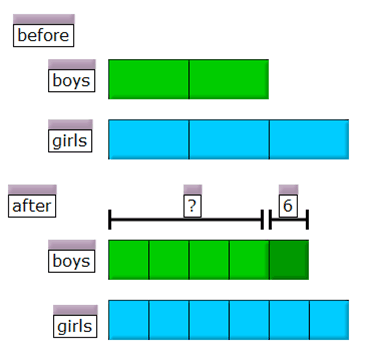
This is a sixth-grade problem from a unit on changing ratios. Can you see the answer? Note that the number of girls doesn’t change.
1 unit = 6 boys
4 units = 24 boys
Mastering Math Makes Math Fun!
Singapore Math® is a great foundation for elementary math success. Working with teachers in their classrooms, I see the impact the materials have on students every day. Singapore math can help make every child in every classroom a competent and confident mathematics student.
Answers to Word Problems
1) Ginny has 16 grape gumballs
2) Paul has 8 gumballs
3) There are 14 boys in the class
4) There were 24 boys in the class at first
Bar Models generated from ThinkingBlocks.com