Singapore Math helps DC charter school improve math proficiency by 83%

Test scores show momentum for charters
The Washington Post 8/4/2011

The Bruce Monroe Elementary School in Washington DC struggled to implement Singapore math, but the school remained committed to the program. In a June 6 article in the Washington Post, the school’s instructional coach, Nuhad Jamal, referred to Singapore Math as “a strength of our school.”

Recently released test scores show a 2011 proficiency percentage of 43.04%, up from 23.42% in 2010. But forget percentage points, let’s talk students. In 2010, 40 of 172 students were proficient in mathematics. In 2011 almost 75 of 174 students were proficient.

Every subgroup showed improvement. Math scores for students classified as Limited English Proficient jumped from 24.14% proficient in 2010 to 51.11% in 2011. Or an increase from 17 of 70 students in 2010 to 36 of 70 students in 2011.

While these score still fall below the school’s proficiency target, they are a start. Here’s wishing the Bruce Monroe school continued success! And some stability.

Meanwhile, here in Colorado, I’m flabbergasted that parents and teachers are telling me that Singapore Math is “too hard” for their students.

Share:

One School’s Challenges with Singapore Math

D.C.’s Bruce-Monroe school faces challenges as it tries Singapore math method
The Washington Post 6/6/2011

If you’ve been wondering what the difficulties are when implementing Singapore math, look no further. This school in D.C. has them all; school closures, lack of enough professional development, mobile student and teacher population, and it’s a dual-language school. Standardized test scores dropped significantly after the change to Singapore math.

The story  evoked responses from many in education. Joane Jacobs mused:

The fact that it ( Singapore Math) requires elementary teachers to understand math well has to be a serious obstacle.

In a letter to the editor dated June 14, 2011, Dr. Alan Ginsburg suggested that the problem at Bruce-Monroe may be bigger than just the Singapore math adoption. He pointed out that the school’s reading scores

declined by 15 percentage points in a single year, and Hispanic students’ scores declined by 21 percentage points.

Bill Jackson, in another great Daily Riff article (Going Beyond Singapore Math: Resisting Quick Fixes), ennumerates the complex issues behind plunking a program like Singapore math into the American classroom.

While most educators familiar with Singapore math agree that it is not the oft-quoted “silver bullet”, Jackson reminds us that:

if we keep throwing out promising ideas just because they don’t immediately improve scores on tests whose quality is questionable at best we’re doomed to repeating the haphazard and fragmented reform efforts that got us here in the first place.

He closes with a word to schools that are currently using Singapore math:

I would like to say that you are definitely moving in the right direction. There will be challenges along the way but they are the same ones you would face with any math program and they can be overcome if you understand the bigger issues behind effective math teaching and learning.

Faced with so many challenges, it’s impressive that Bruce Monroe’s  instructional coach, Nuhad Jamal remains upbeat about the school’s Singapore math adoption.


Share:

Singapore Math School Videos

Two videos were recently published by schools that adopted Singapore math programs last school year.

Melrose Elementary School Mathematics/Science/Technology Magnet has seen impressive results with its new Singapore Math program, Primary Mathematics. Math Coach Lacy Endo-Peery announced:

We had a 32% increase in students who were advanced or proficient in Math last year. Our students went from 43% to 75 % in one year!

The school has put together an informative 8-minute video about their experiences with Singapore Math. It’s always helpful to hear teachers sharing the reasons why Singapore math works with their students, the importance of sustained training, and why the school selected Singapore math.

[vimeo]http://vimeo.com/25362323[/vimeo]

Singapore math materials tend to be light on practice for mastering math facts. To compensate for that, many schools supplement using the activity in the video referred to as a math sprint. These were designed by Professor Yoram Sagher (also in the video) and are used widely in U.S. schools. While sprints are designed to help students become fluent with computation, they are not a part of the Singapore math curriculum. (Sprint books for teachers are available at SingaporeMath.com.)


Reynolds School District in Fairview, Oregon is expecting student achievement to rise with their adoption of the Math in Focus version of  Singapore math materials. Before the adoption, the 12 elementary schools in the district were using different curricula, which was an issue for students that changed schools within the district. In the video, both teachers and students report how much they like the visual component of the materials.

[vimeo]http://vimeo.com/25147891[/vimeo]
Share:

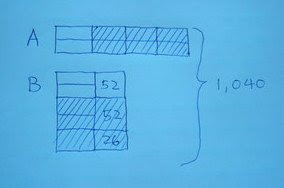
Bar Model Method challenges

Photo taken in a third grade classroom using Primary Mathematics. The teacher had posted the question on the board and students recorded the question and their solution in a math journal.

Discuss.

Share:

Recent Singapore Math in the news

Photo credit Monica Lim

There have been several items in various news outlets this past week.

From Boston.com comes the story: Wellesley math teachers learn Singapore techniques from Tenacre specialist

Although the Wellesley district  is not considering adopting a Singapore Math curriculum, they asked a a teacher from another school to demonstrate one of Singapore Math’s well-known strategies, the bar model method of  solving word problems. Jen MacPherson, Wellesley Public Schools’ elementary math coordinator may look at further professional development for the teachers:

Kids struggle with word problems. This is an easy tool to use in any curriculum.

Model drawing is a hot topic! The School Board in Briarcliff agrees. Their budget includes:

Approval for consultants to train kindergarten through sixth grade teachers in the Singapore Math Model Drawing Method.

And in the Honolulu Star-Advertiser is a brief snippet amongst a story about a Hawaiian charter school that began in a chicken coop:  With stable teaching staff and financial aid, Waianae school is model for student success

Principal Alvin Parker cites Singapore Math as helping the school meet turnaround goals:

The school adopted Singapore Math in the fall of 2009, and math proficiency jumped from 27 percent of students to 37 percent over the course of that school year, helping the school make “adequate yearly progress.”

Finally, blogger writes about her life with kids in Singapore and periodically includes interesting math problems as well as issues with the PSLE and education in Singapore. She recently posted a couple of interesting problems and student solutions: Revisiting maths models.


Share: